Risk Management Training

Anticipate uncertainties, identify threats, leverage opportunities, and secure project outcomes

In an uncertain and constantly evolving environment, risk management has become a critical strategic capability. Whether for projects, programs, or operations, the ability to identify, assess, and control risks is key to ensuring success while avoiding costly disruptions.

This training offers a structured approach and practical tools to anticipate threats, turn risks into opportunities, and strengthen the resilience of your initiatives. Combining theory, hands-on exercises, and real-world case studies, it is designed for professionals seeking to secure their activities and make informed, high-impact decisions.

Risk Management: the training that equips you with the key capabilities to identify, assess, and control risks, ensuring project success while avoiding costly disruptions.

Training Objectives

By the end of this training, participants will be able to:

  • Understand the fundamental concepts of risk management
  • Identify risks across projects and initiatives
  • Assess risk probability and impact
  • Develop effective risk mitigation strategies
  • Implement robust risk monitoring and control mechanisms

Target Audience

This program is specifically designed for the following profiles:

  • Project managers
  • Project directors
  • Program managers
  • Project analysts
  • Engineers involved in complex projects
  • Risk management professionals

Prerequisites

Basic knowledge of project management is recommended.

Duration & Format

  • Duration: 2 days (14 hours)
  • Format: On-site or hybrid
  • Option: Tailor-made adaptation available
  • Language: English or French
  • Pricing: Upon request

Expected Outcomes

Organizations implementing this training typically achieve:

  • Reduced costs and project delays
  • Improved anticipation of risks and issues
  • Stronger decision-making under uncertainty
  • Higher project success rates

Training Program

Module 1 – Introduction to Risk Management

  • Definition of risk
  • Difference between risk and issue
  • Role of risk management in projects

Module 2 – Risk Identification

  • Brainstorming techniques
  • Document analysis
  • Stakeholder analysis
  • Lessons learned

Exercise: Identify risks within a project.

Module 3 – Qualitative Analysis

  • Probability
  • Impact
  • Criticality

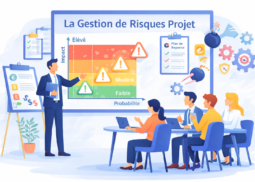
Tool: Risk matrix.

Module 4 – Quantitative Analysis

  • Scenario analysis
  • Impact estimation
  • Monte Carlo simulation (conceptual overview)

Module 5 – Response Strategies

  • Avoid
  • Mitigate
  • Transfer
  • Accept

Development of a mitigation plan.

Module 6 – Monitoring & Governance

  • Risk register
  • Periodic reviews
  • Early warning indicators

Continue your development in project management

Ready to structure your projects and reduce risk?

Download the BSC Methodology Guide

Error: Contact form not found.