




Food & Beverage
Enhancing reliability, productivity and operational profitability in food manufacturing
The Food & Beverage Industry: High Pressure, High Expectations
Food and beverage manufacturers operate in one of the most demanding industrial environments.
They must simultaneously manage:
-
High production volumes and tight margins
-
Strict food safety and regulatory requirements
-
Continuous or high-speed production lines
-
Increasing cost pressure on energy, labor and raw materials
-
Growing demand variability and product diversification
In this context, equipment reliability and operational efficiency are critical drivers of profitability.
Unplanned downtime, inefficient maintenance practices or poorly managed spare parts can rapidly translate into production losses, quality issues, and increased operational costs.
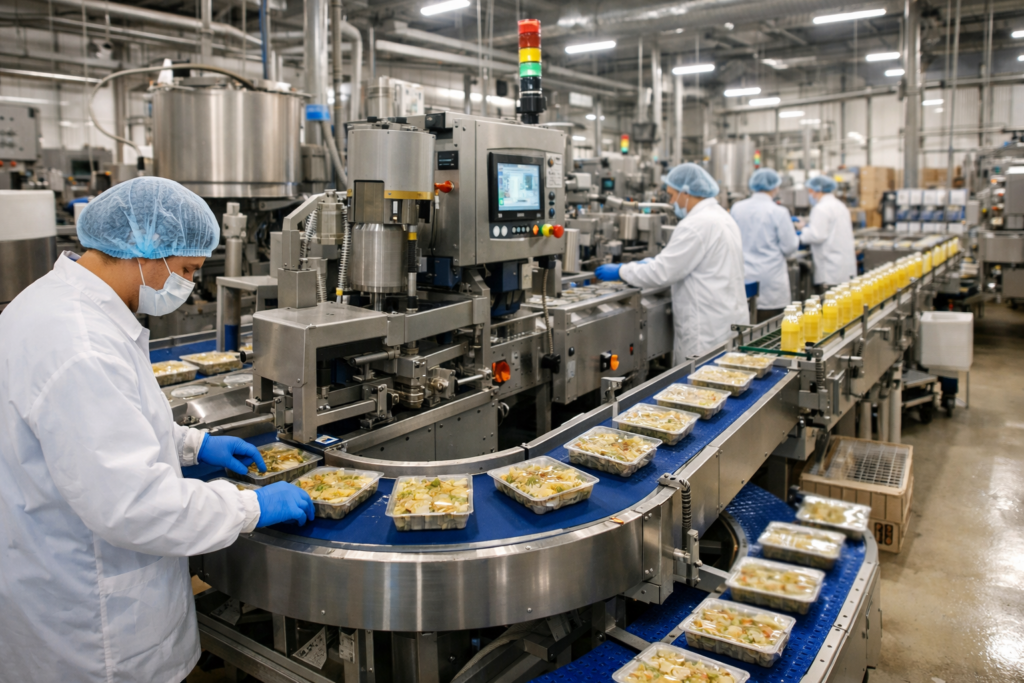
Brains & Solutions Consulting (BSC) supports food and beverage manufacturers in strengthening manufacturing reliability, operational performance and long-term profitability.
Key operational challenges in Food & Beverage manufacturing
Food and beverage production systems combine high-speed processing, strict hygiene and quality constraints, and complex industrial equipment.
This creates a unique set of operational risks:
Production continuity and downtime risk
Even short equipment failures can lead to:
-
production losses
-
product waste
-
missed delivery commitments
Hygiene and compliance constraints
Maintenance operations must comply with strict regulatory and sanitary requirements such as:
-
HACCP frameworks
-
traceability standards
-
food safety regulations
Complex multi-site operations
Large food manufacturers often operate multiple production plants, each with different equipment configurations and maintenance practices.
This leads to:
-
inconsistent maintenance strategies
-
inefficient spare parts policies
-
uneven operational performance across sites
Asset performance and profitability
Poorly structured maintenance and asset management practices can significantly affect:
-
OEE (Overall Equipment Effectiveness)
-
maintenance costs
-
production capacity
-
working capital tied up in inventories
How BSC Supports Food & Beverage Manufacturers
We support the food and beverage industrials through a pragmatic and structured approach focused on four core pillars:
Our objective is simple: transform maintenance and asset management into a strategic lever of industrial performance.
Our interventions combine engineering rigor, operational expertise and strong field implementation capabilities.
From strategy to measurable results
Our value lies in our ability to translate strategy into execution and to deliver measurable, sustainable performance improvements in real industrial environments.
Our teams combine deep shop-floor expertise, structured methodologies, and pragmatic execution to ensure that improvement initiatives deliver tangible business impact, not just recommendations.
*Measured results achieved within 12 to 36 months across completed engagements
Proactive Maintenance & Reliability Engineering Moving from Reactive Maintenance to Industrial Reliability
In many food production plants, maintenance still operates in reactive mode, responding to breakdowns rather than preventing them.
We help organizations transition toward proactive and reliability-driven maintenance strategies, enabling stable production and predictable performance.
Our approach combines engineering analysis with structured operational deployment.
Reliability Engineering Foundations
Our teams implement proven reliability methodologies widely used in industrial sectors:
-
ISO 14224 – Maintenance and reliability data management
-
IEC 60300 – Dependability engineering framework
Our key tools and solutions include:
-
EMP – Equipment Maintenance Plan development
-
FMEA / FMECA failure mode analysis
-
RCM – Reliability-Centered Maintenance strategy definition
-
Failure pattern analysis and risk prioritization
These methods ensure maintenance activities are aligned with real operational risks.
Proactive Maintenance Program & Strategy
Through our Proactive Maintenance Strategy & Program, BSC supports manufacturers in structuring maintenance at plant or multi-site level.
Typical interventions include:
-
Diagnostic 360 of the maintenance maturity
-
Definition of a maintenance strategy aligned with business priorities and integrating Maintenance for Quality
-
Development of standardized maintenance plans
-
Implementation of structured maintenance processes, tools and governance systems
-
Targeted improvement initiatives on critical assets (quick wins)
-
Coaching and training of internal teams
Objective: establish a sustainable maintenance system that reduces failures and stabilizes production performance.
For multi-site food manufacturers, BSC supports the deployment of harmonized maintenance strategies across several plants.
Spare Parts Management Optimization Controlling Inventory While Protecting Production
Spare parts represent a critical balance in food manufacturing:
-
Excess inventory locks working capital
-
Insufficient stock increases downtime risk
Many organizations accumulate large inventories without a clear strategic structure.
BSC helps companies optimize spare parts management through:
-
Asset criticality analysis
-
Spare parts classification and risk mapping
-
Consumption pattern analysis
-
Multi-site spare parts strategy
-
Inventory optimization and stock reduction
The goal is to reduce capital immobilization while securing operational continuity.

Operational Profitability & Production Stability Eliminating Chronic Process and Equipment Losses
In high-volume food manufacturing, a small number of problematic assets can generate a disproportionate share of operational losses.
These losses often originate from:
-
Recurrent equipment failures
-
Underperforming production lines
-
Lack of asset prioritization
-
Inefficient problem-solving processes
BSC deploys structured programs to identify and eliminate these sources of inefficiency.
BAM – Bad Actor Management
Identification and treatment of the equipment generating the largest operational losses, based on a FRACAS approach.
P2Mi – Asset Criticality Analysis
Structured prioritization of equipment based on operational and business impact.
Loss Elimination Programs
Identification, quantification and elimination of structural production losses to improve productivity, availability and overall operational profitability.

Maintenance Excellence Training Developing High-Performance Industrial Teams
Sustainable performance transformation requires more than tools and methods. It requires skilled teams capable of sustaining improvement.
We provide specialized training programs in Manufacturing Excellence and Maintenance Management designed for maintenance teams, reliability engineers, production managers and plant leadership.
Our training programs include:
-
Maintenance organization and management
-
Reliability engineering fundamentals
-
Preventive maintenance optimization
-
Maintenance planning and scheduling
-
Root cause analysis methods
-
Maintenance performance management
All training programs combine practical industrial case studies, applied workshops, operational implementation tools

Strategic Impact
- Improved equipment reliability
- Increased production stability
- Reduced maintenance costs
- Optimized spare parts inventories
- Higher operational profitability
Who we support in the Food & Beverage
- Food processing manufacturers
- Beverage producers
- Dairy and cold-chain operators
- Large-scale industrial kitchens
- Packaging or Bottling facilities
- Multi-site manufacturing groups
Our interventions apply to both single-plant improvement initiatives and global manufacturing transformation programs.
Why Food & Beverage Manufacturers choose BSC
- Deep expertise in industrial maintenance and reliability engineering
- Proven methodologies adapted to high-volume manufacturing environments
- Proven experience in food and beverage, critical and highly automated industries
- Strong experience in multi-site industrial organizations
Our consultants have extensive experience in complex industrial environments and work closely with production, maintenance and engineering teams to deliver tangible and sustainable performance improvements.